Designing For Growth
Overview
BillGO's white-label bill pay platform had a churn crisis I couldn't measure: most new users abandoned the product within their first week. Compliance rules blocked all access to end-user data. I built the company's research infrastructure from scratch, prioritized a backlog of friction points by stress and drop-off risk, and shipped three solutions. Capital One reported meaningful retention improvement, and one regional credit union saw a 30% reduction in churn.
Role
Senior Product Designer @ BillGO
Team
2 PMs, 2 engineers, a UX researcher
Context & Challenge
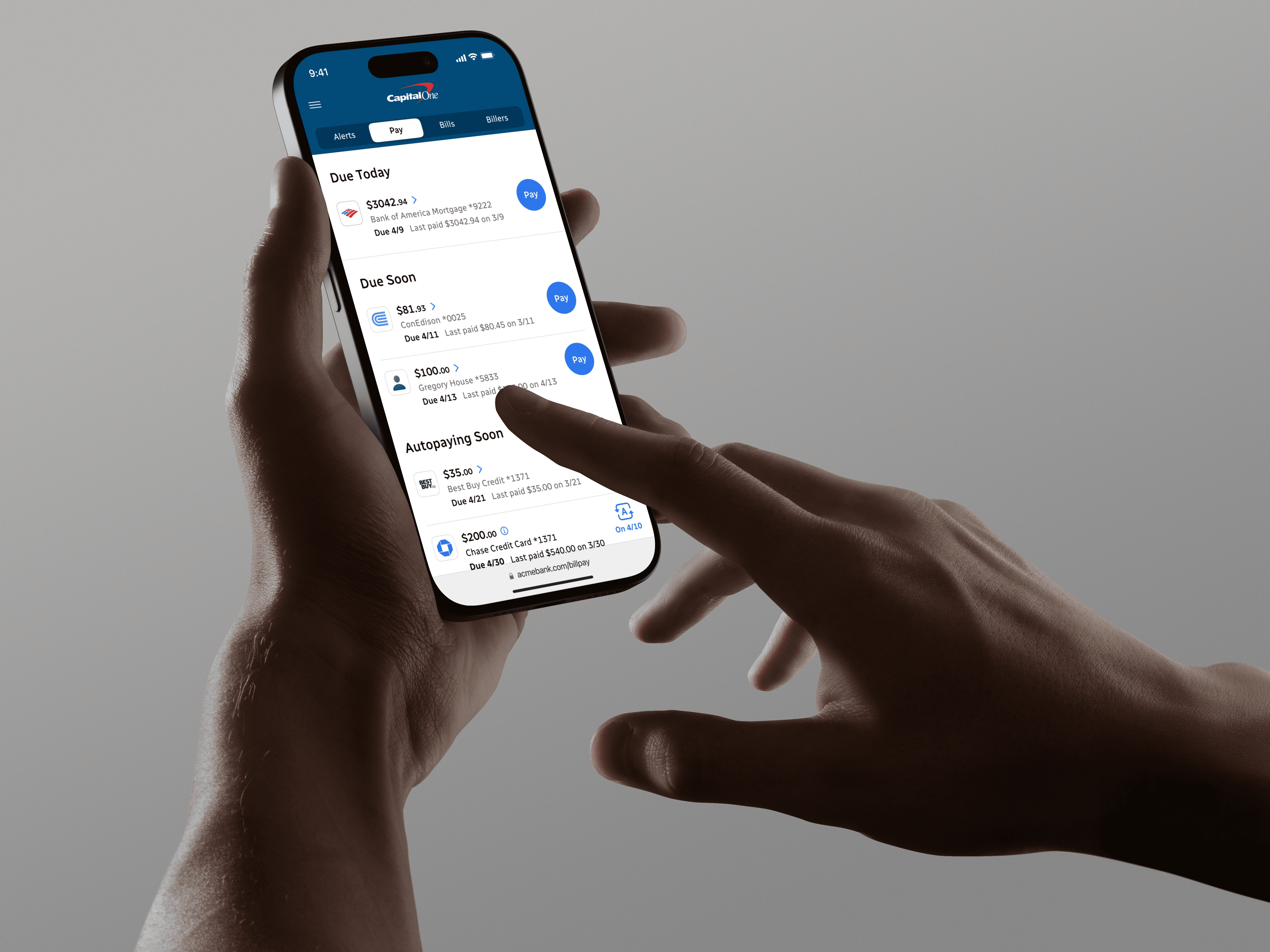
BillGO's platform consolidated everything from utilities to mortgages into one place, embedded directly inside the ecosystems of major US financial institutions.
Capital One, our biggest client and investor, was facing an extremely high churn rate: the majority of new users abandoned bill pay within their first week. When money is on the line, any friction reads as a reason to leave. That framing became the backbone of the entire project.
There was a second problem stacked on top of the first. Legal and compliance constraints prevented Capital One from sharing any end-user data with us. No funnels, no session recordings, no support tickets. The product team and I had to identify and solve the churn drivers blind.
So before I could design anything, I had to design a way to see.
Building The Research Infrastructure
Rather than treating the data blackout as a blocker, I treated it as a discovery problem and stood up three research streams the company didn't have before.
Internal walkthroughs. I partnered with our PM and VP of Product to recruit 20–30 internal participants and ran about 10 moderated sessions over 8 months. Participants completed real tasks: setting up billers, making payments, managing accounts. Because they were real people with real bills, their friction was real too.
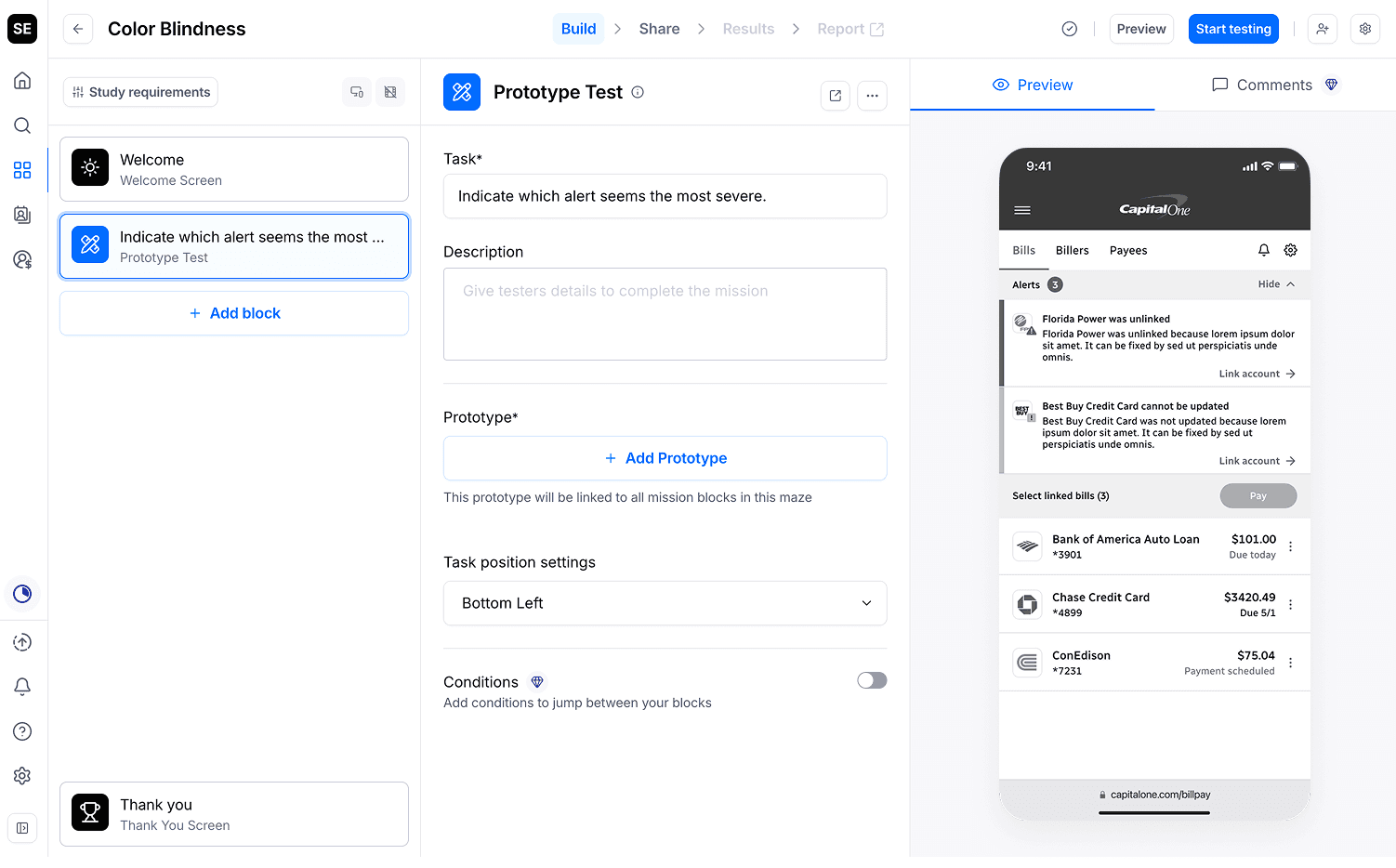
Online usability testing at scale. Nobody asked me to bring in a new tool. I pitched Maze to BillGO, ran the first studies myself to prove the value, and built the testing templates that the wider design team went on to adopt as their standard. This gave us 100+ participants from across the country and let us test language, iconography, flow completion, CTA clarity, task speed, and accessibility between releases.
Ethnographic research. I collaborated with our UX researcher, Dana, on in-depth ethnographic studies. We went beyond the clicks and into the psychology of debt and bill management. This research also revealed that bill-paying patterns varied significantly by generation, which let us design for specific mental models instead of a one-size-fits-all flow.
Hypothesis and Prioritization
My working hypothesis: money is stressful, and paying bills is stressful for the average American. Any UX friction becomes a trigger to jump ship. The research validated this completely.
To turn findings into a roadmap, I mapped every friction point on a two-axis matrix: stress risk versus drop-off risk. Surprise payment failures, ambiguous forms, and slow biller linking landed in the danger quadrant. Nice-to-haves like power user features and a payment planner fell to the backlog.
Before the matrix, product and engineering each had their own list of what to fix. The matrix is what ended that argument. It became our shared prioritization artifact, let us sequence the work into focused, sprint-sized problems instead of a vague mandate to "fix churn," and gave stakeholders a transparent rationale for what we were not doing yet. The artifact mattered because it moved a room, not because it was a diagram.
Three solution areas came out of it: slow biller linking, payment blockers, and the onboarding gap.

Solution 1: Slow Biller Linking
Discovery. Walkthroughs surfaced an average 1–5 minute wait when linking a biller, and 7 of 20 users experienced waits of 20–50 minutes. Utilities were the worst offenders, and participants in rural areas waited longest. The existing UI held users hostage on a loading screen the entire time.
Constraint. I reached out to engineering leadership to understand the infrastructure behind the wait times. They couldn't be eliminated. This is where design had to absorb a technical constraint rather than wish it away.
Solution. I redesigned the flow so users could exit and continue using the platform while linking finished in the background, regardless of wait time. It tested well with all 20 walkthrough participants and again in online usability testing.

Solution 2: Payment Blockers
Discovery. Auto-payments would fail on the day of the payment for 9 of 30 participants, again disproportionately on utility bills. The platform only notified users on the day of failure, with no explanation and no resolution path. Internally, this had been accepted as an edge case. For a product built on trust, a surprise failed bill payment is about the worst thing that can happen. Getting the organization to reclassify it from edge case to core trust problem was as much of the work as the design that followed.
Iterations. I partnered with engineers to build an alert system that flags payment blockers ahead of time and tells users exactly what the problem is, how it affects their payment, and how to fix it. I collaborated closely with a Senior Product Designer to refine language, tone, and hierarchy, then ran usability testing with 60+ participants, asking each to interpret every alert and describe their next action. I iterated on copy and CTAs until users responded with clarity and confidence, and incorporated feedback from Capital One's design team.
Shipped, with a trade-off. My preferred design was a dedicated Alerts tab, which gave alerts room to breathe and decluttered the payments page. An engineering constraint forced alerts onto the home page instead, so I designed a collapse behavior for high-alert accounts and carried alert signifiers through the rest of the platform wherever a biller or bill had issues. I argued for the tab, lost on the constraint, and protected what mattered: no user is ever surprised by a failed payment again.
Solution 3: The Onboarding Gap (A Deliberate Bet)
I theorized onboarding could be a major drop-off driver, but we had no way to test it internally. Rather than guess, I made a deliberate choice to deprioritize a full onboarding redesign and bet that contextual guidance throughout the platform would be more effective.
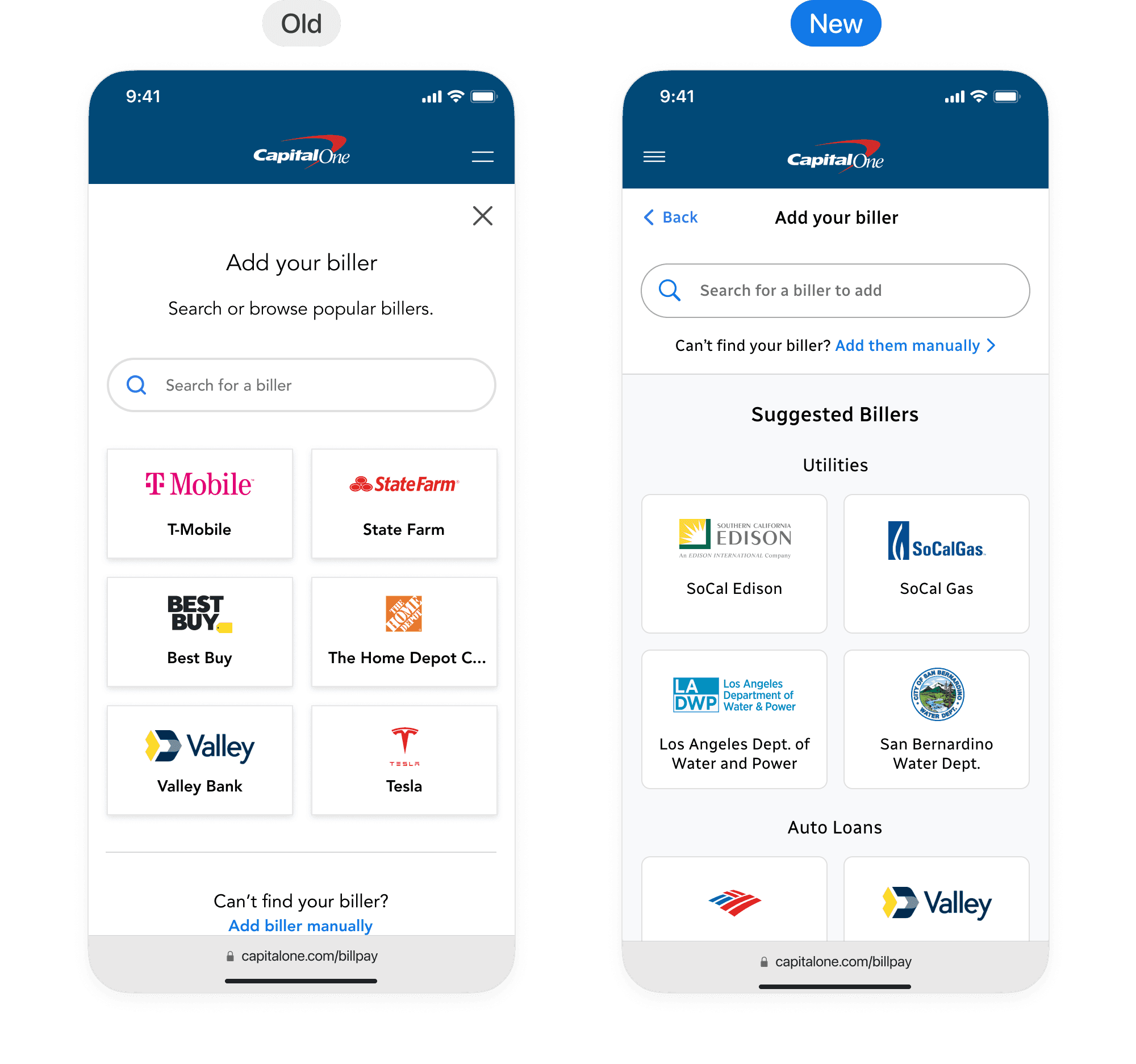
One example: the "Add Biller" screen originally asked users to search a directory or pick from a generic popular list. New users hesitated because they didn't know which billers were supported and the list rarely felt personal. Drawing on the ethnographic research about which bills Americans prioritize, I redesigned it to surface local utilities based on the user's location, followed by auto loans and insurance. Even when suggestions weren't a perfect match, the screen now communicated immediate value. In testing, the hesitation disappeared.
The bet didn't always pay off. Some concepts stayed confusing for users, which kept me iterating throughout the project. I'm including this because a prioritization decision with a visible cost is still a decision, and I'd make the same call again with the same constraints.
Results
We used an iterative rollout strategy, with qualitative feedback from the Capital One team as our compass while direct data stayed restricted.
Capital One Retention
Capital One reported that month-long retention spiked significantly.
Regional Bank Retention
A bank in New Jersey reported there was a 30% increase in millennial user retention.
Business Impact
Both BillGO and our clients marketed bill pay to audiences more effectively.
Team Impact
Processes like online usability testing and internal walkthroughs became the norm.
Next Steps and Reflection
The roadmap I left behind included a design system, tools for power users, and AI-assisted features.
What this project taught me is that the absence of data is not the absence of process. When compliance walls went up, the answer was to build research infrastructure, prioritize ruthlessly, and let qualitative signal compound across sprints. Designing for trust turned out to be less about polished screens and more about never letting the user be surprised.
One mistake I made was verbally committing to designing onboarding before I had done any discovery. So I had to later walk back on my commitment carefully to ensure the best UX possible. I wouldn't say this is bad design practice, especially in the age of AI, but it's bad client management. I now set discovery expectations with my clients from the start.